Upload a past paper and Tali reads it question by question — then writes you a note for each exam point it tests. CFA, PMP, CPA, university finals.
Start prepping freeMost exam prep tools start from a subject. You pick a topic, they hand you a bank of questions written for somebody else's exam, and you spend a fortnight discovering which third of it your paper does not test. Tali starts from the other end. You upload the exam material you already have — the syllabus, the handouts, last year's paper — and everything you study is derived from that.
Drop in the past paper, the mock, the syllabus, the lecture handouts. PDF, DOCX, PPTX, Markdown, plain text, or a photo of the page, up to 30MB a file. You don't tick a box marked 'this is an exam' — Tali reads the file and works out what it is: a paper full of solvable problems, or reading material to be learned. The two get handled differently, because they are not the same problem.
On a paper, Tali extracts each question in full and verbatim: every given condition, every numbered construction step, the whole setup, LaTeX intact. Nothing gets abbreviated to an ellipsis. When four sub-questions hang off one diagram, the shared setup is repeated into each of them so every question stands on its own — and each one keeps the number it had on the original paper, and a link back to the paper it came from.
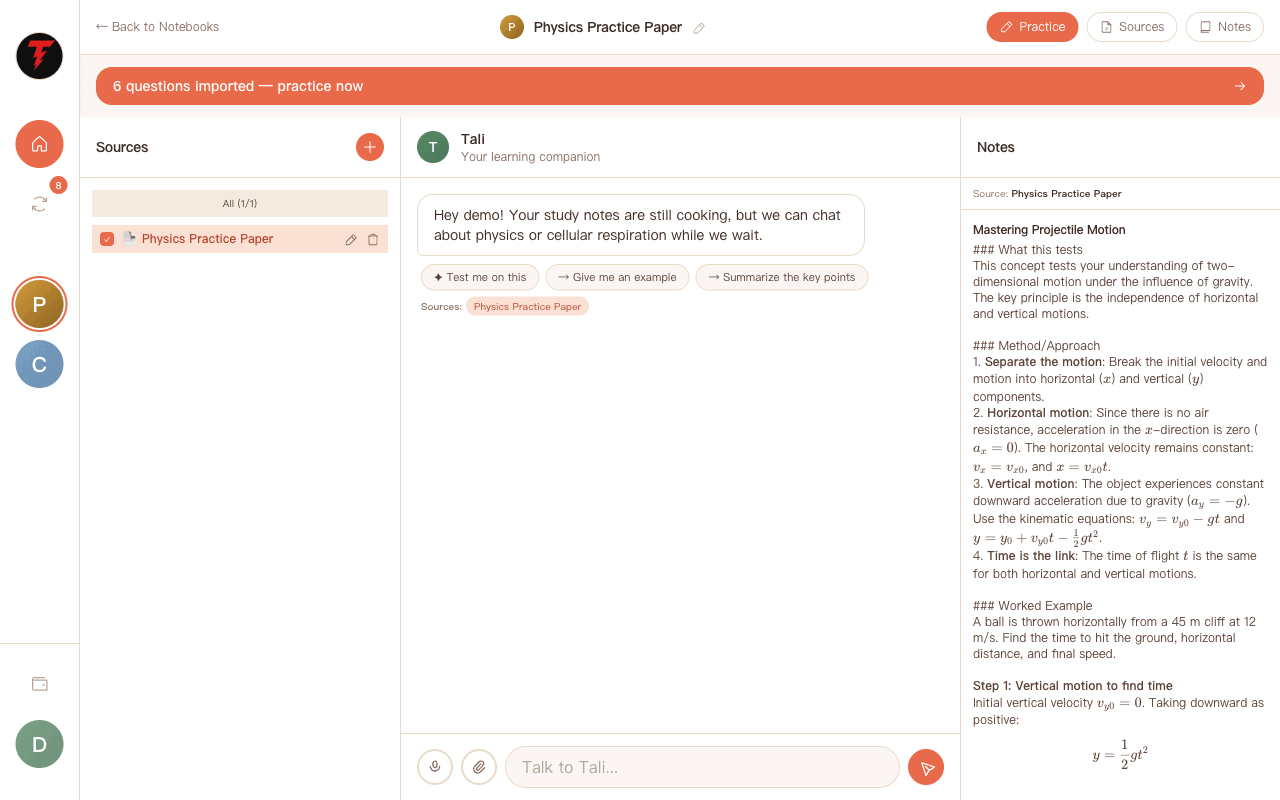
Tali groups the extracted questions by the concept each one tests and writes one study note per concept: what this exam point actually asks of you, the method for attacking it, one fully worked demonstration, and the traps people fall into. The questions themselves become practice you can sit — answered, marked and scheduled like everything else in Tali.
Pasting a past paper into a chatbot gets you help with one question at a time. Exam prep is everything around that: going back to the questions you got wrong, and knowing which exam points are still open.
| General AI chatbot | Tali | |
|---|---|---|
| Works through a past-paper question with you | Yes | Yes |
| Turns a past paper into questions you can re-attempt any time | — | Yes |
| Tracks which exam points you have proven, across every session | — | Yes |
| Brings back the questions you missed on a schedule | — | Yes |
| Daily pace from your exam date, and a last-round email the night before | — | Yes |
If you only need one question explained, any good chatbot will do. If you have a paper to sit on a date, Tali keeps track of the part a conversation forgets.
A commercial bank for a certification is written against the curriculum in general. Your paper is a specific instrument: it leans hard on a few topics, barely touches others, and asks in a particular way. Tali doesn't have a bank. It has your paper, pulled apart question by question, and everything it writes for you comes off those pages — in your material's own terminology.
A textbook is organised in the order it was written. A paper is organised by what it tests. Tali groups every question it extracted by the concept behind it and writes one note per concept — so when three questions turn out to be the same idea in different clothes, that becomes one note with a full derivation in it, rather than three questions you keep re-attempting separately.
Geometry, circuits, free-body diagrams, graphs — these are the questions that die when a paper is flattened into plain text. Tali marks the questions whose figure you need in order to answer, redraws each one as a clean vector figure carrying the labels from the original paper, and produces the worked solution while it can still see the diagram. So you can revise on your phone without the paper in front of you. Up to 20 figure questions per upload get a drawn figure; past that they still import, just without one.
A physics mock and a history handout do not want the same treatment. Tali classifies your upload first. Problem-solving material — maths, physics, chemistry, biology, anything with a definite worked answer — gets pulled apart into questions. Essays, passages, chapters and lecture handouts go down the normal note path and have practice generated from them instead. And when it can't confidently read your file as a paper, it summarises it rather than inventing a question bank to fill the gap.
CFA, PMP, CPA, actuarial papers, the cloud certs. You have the official curriculum and a stack of practice papers, and the gap between reading the curriculum and passing the paper is the entire problem. Upload the practice papers as you work them, and let the exam points rather than the chapter numbers become the shape of your revision.
Every student works out eventually that the department reuses its question types. Upload the last few years of papers and the concepts that come back every single year stop being a hunch — they are the notes that keep appearing. Upload the lecture decks alongside them and the material and the exam finally sit in the same place.
An answer key that stops at a single boxed number tells you nothing about where your derivation went wrong. Tali writes the solution out in full — the key concept, then numbered steps with the actual working — and if you get a question wrong you can ask for a fresh variant on the same idea and try it again.
You get 15 free credits when you create an account, no card required. Importing a paper is where credits go: one credit covers a source of up to 20 sections — its notes, every question pulled out of it, unlimited answering and spaced review. A figure question that comes back with a redrawn diagram and a worked solution is included too. Only the open-ended things are metered: one credit buys 12 chat messages or 2 minutes of voice. Answering the questions afterwards is free, however many times you come back to them. No subscription required; you top up when you generate something new.
ChatGPT can work through a past-paper question with you, and that's useful. Tali turns the paper into practice you keep: it pulls out each question (redrawing figures where it needs to), files them into your course so you can re-attempt them any time, writes one note per exam point, and tracks which points you have proven. Set your exam date and it tells you how many topics to cover per day; the night before, it can send one email with the topics that are still shaky.
No, and there is no toggle to find. Every file you upload is read and classified first, then routed: a paper of solvable problems is taken apart into its questions, while reading material is summarised into notes and turned into practice. This is deliberately done before anything is generated — otherwise you'd get a bland summary of a document that was actually a physics paper.
Different things, honestly. A past paper is where the exam-aware pipeline earns its keep: the questions get extracted, grouped by concept, and turned into notes about those exam points. A syllabus, a curriculum PDF or a lecture handout is reading material — it goes down Tali's normal path, becoming structured notes with practice questions generated from them. Both are worth uploading. Only one of them contains questions to extract.
The question text is reproduced from your paper — completeness is what the extraction is built around, and the stem should read exactly as it was printed. The worked solution is the AI's, and that is the part to keep an eye on: it can misread a figure, or take a wrong turn in a derivation. Every question keeps its original number and a link back to the paper you uploaded, so checking one against the source is quick. On a very long paper the import can also come up short — it will drop the tail rather than hand you a half-copied question, so what you get is fewer questions, not mangled ones.
PDF, DOCX, PPTX, Markdown, plain text, and photos or screenshots of pages (PNG, JPG, WEBP, HEIC), up to 30MB per file. Upload papers one at a time rather than as a merged decade of past exams — the extraction is tighter, the exam-point notes are cleaner, and you were going to work through them one paper at a time anyway.
Your material is used to generate your own notes and practice, and for nothing else. It isn't shared and it isn't sold. You can delete a source whenever you like: the notes written from it go with it, while the questions imported from it stay in your practice — they've become part of your own question set by then, and that's usually what people expect.
Drop in a PDF and get notes you can actually study from — then let Tali quiz you until you can explain it.
Upload the chapter you have to know cold. Tali writes the questions and schedules them — what you miss comes back tomorrow, what you know comes back in a month.
Not generic questions — questions from the exact chapter you just read, marked by something that tells you what you missed.
Upload the same PDF you'd drop into NotebookLM. Tali turns it into quizzes, grades what you write, and keeps bringing back what you got wrong — so you don't just chat with your notes, you learn them.
Ask your PDF anything and get answers grounded in the page. Then let Tali quiz you on it, mark what you write, and resurface what you missed — because chatting with a document isn't the same as knowing it.
If that's happened to you, the problem isn't effort — it's that nothing you're using can tell you which topics you only think you've got. Tali works from your own material, quotes the exact source for every supported point, and gives you that list.
ChatGPT is a great explainer. Tali is for the weeks before an exam: questions from your own material, a record of which topics you have actually proven, and the shaky ones brought back on schedule.
No set to build, no set to hunt for. Upload the chapter you're being tested on and Tali turns it into practice questions — and practising them is free.
