Upload the chapter you have to know cold. Tali writes the questions and schedules them — what you miss comes back tomorrow, what you know comes back in a month.
Start reviewing freeSpaced repetition is not the hard part — everyone knows it works. The deck is the hard part. Writing a good question takes longer than reading the page it came from, so the deck never gets finished, the schedule never gets going, and by exam week you are cramming like everyone else. Tali removes that step entirely: the questions come out of your own material, and the schedule starts the moment you answer one.
The lecture deck, the textbook chapter, the standards document, the 300-page curriculum. Tali reads it and writes practice questions from it — single choice, multiple choice, fill-in-the-blank, true or false, and open-ended questions it reads and marks in prose. You do not sit there typing out prompts and answers.
Every question you answer joins your review queue automatically, whether you got it right or wrong. There is no add-to-deck button because there is no deck to add to. Your queue is simply everything Tali has asked you, ordered by the date you are about to forget it.
Your review page shows what is due today and nothing else. Each item returns with its answer and its explanation; you say whether you actually had it — Again, Hard, or Easy — and that one tap sets the next date. Reviews earn XP and count toward your daily goal, so keeping the queue clear keeps your streak alive.
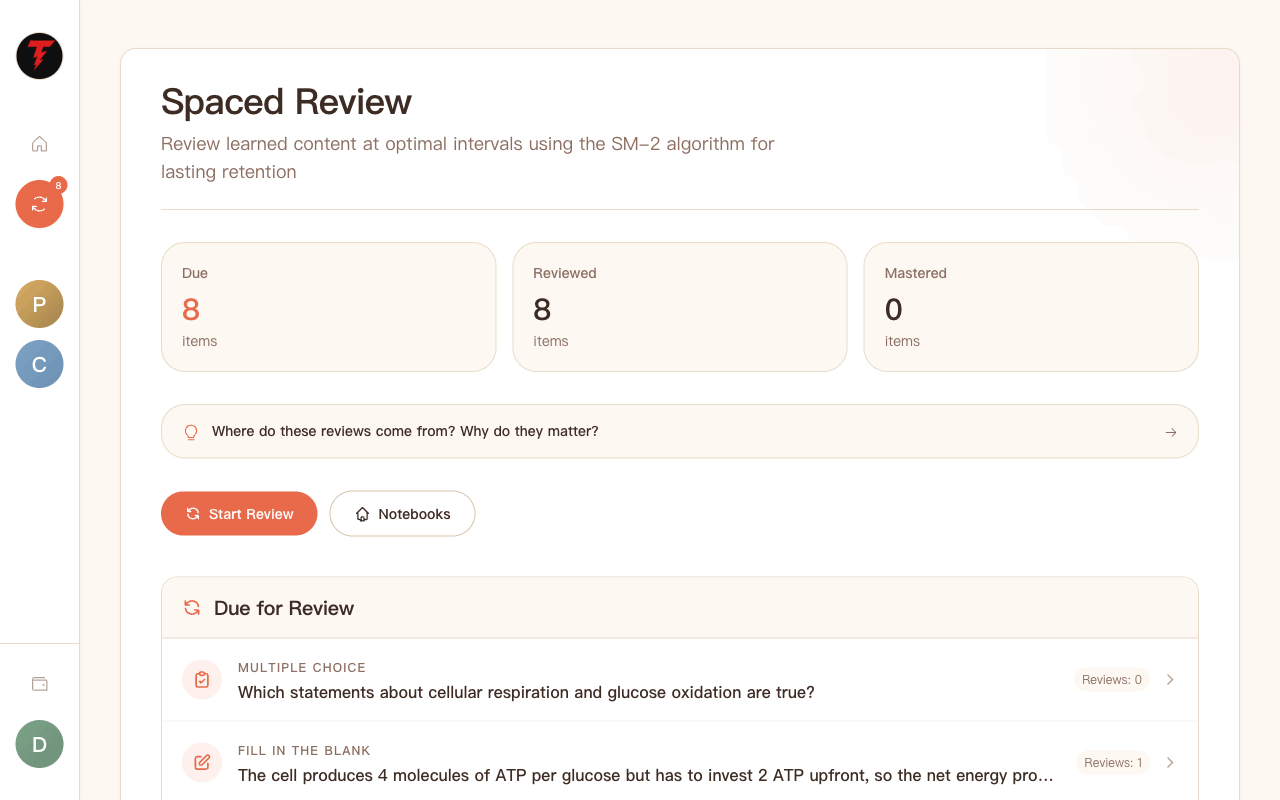
Tali runs SM-2, the algorithm SuperMemo introduced. In practice: recall an item and it comes back a day later, then six days later, and after that each success multiplies the gap by that item's own ease factor, which starts at 2.5. Fail it and the interval drops straight back to one day. The ease factor moves with your ratings and never falls below 1.3, so the material you personally find hard stays close and the material you find obvious walks out to weeks and then months.
The most common way a review habit dies is the deck-building session you keep postponing until it is too late to matter. Tali generates the questions from the pages you uploaded, so the queue is already populated before your motivation runs out — including the boring, necessary items you would never have had the patience to make yourself.
Telling yourself you knew it is fast, and it is easy to cheat. Any item in the queue has a variant button: Tali writes a new version of that same question and marks your answer properly. Get the variant right and the original moves forward in the schedule — you graduated it by answering, not by grading yourself.
Each question in the queue was generated from a specific piece of your material and carries its explanation with it, plus an explain button when the explanation is not enough. You are never staring at a fact you copied out of context six weeks ago and can no longer place.
CFA, PMP, CPA, actuarial papers. You will finish reading the curriculum months before you sit the exam, and the whole problem is what is still in your head by then. Answer the questions as you go through each reading, and the schedule keeps chapter 2 alive while you are busy with chapter 14.
You learned week three's material in week three and have not touched it since. Upload each week's slides as they come, answer the questions once, and the finals-week problem — nine weeks of material you half-remember — largely does not happen.
Definitions, statutes, drug names, accounting treatments, vocabulary in a language you are learning. There is no clever shortcut for this material; there is only being asked again at the right interval. Tali takes the terms from your own textbook rather than a generic list, and can ask you in the language you think in.
You get 15 free credits when you create an account, with no card required. Turning a file into notes and questions spends one credit per source of up to 20 sections; reviewing what is already in your queue spends nothing. The schedule itself never bills you — you can drill an old chapter every morning for a month without spending a thing. Chat and voice are the metered parts: one credit buys 12 chat messages or 2 minutes of voice. No subscription required; you top up only when you generate something new.
SM-2. The first successful recall of an item sets the next review one day out; the second sets it six days out; from then on each success multiplies the interval by that item's ease factor, which starts at 2.5 and rises or falls depending on whether you rated the recall Easy, Hard, or Again. It never drops below 1.3. A failed recall resets the interval to a single day and the item starts climbing again. The numbers are not a marketing metaphor — that is the arithmetic running on your queue.
No. That is the whole point. Tali generates them from the material you upload — single choice, multiple choice, fill-in-the-blank, true or false, and open-ended questions that it marks and comments on. You review the ones it wrote. If a particular question is not useful, skip it; the ones you answer are the ones that get scheduled.
PDF, DOCX, PPTX, Markdown, plain text, and photos or screenshots of pages (PNG, JPG, WEBP, HEIC). Up to 30MB per file. A textbook is better uploaded a chapter at a time — the questions come back tighter, and you will be studying chapter by chapter anyway.
They are written from your file rather than from whatever a model half-remembers about the subject, so they stay on your syllabus and use your material's terminology. It is still AI, though: it can misread a table or ask something the chapter never really claimed. Every item carries its explanation, and there is an explain button when you want the reasoning — if something looks wrong, check it against the source you uploaded.
Nothing expires and nothing is deleted. The review page shows you what is due, oldest first, twenty at a time, and you work through as many as you have time for; the rest stay due until you get to them. Items you have clearly forgotten after a long gap simply reset to a one-day interval, which is exactly what should happen to them.
Drop in a PDF and get notes you can actually study from — then let Tali quiz you until you can explain it.
Not generic questions — questions from the exact chapter you just read, marked by something that tells you what you missed.
Upload a past paper and Tali reads it question by question — then writes you a note for each exam point it tests. CFA, PMP, CPA, university finals.
Upload the same PDF you'd drop into NotebookLM. Tali turns it into quizzes, grades what you write, and keeps bringing back what you got wrong — so you don't just chat with your notes, you learn them.
Ask your PDF anything and get answers grounded in the page. Then let Tali quiz you on it, mark what you write, and resurface what you missed — because chatting with a document isn't the same as knowing it.
If that's happened to you, the problem isn't effort — it's that nothing you're using can tell you which topics you only think you've got. Tali works from your own material, quotes the exact source for every supported point, and gives you that list.
ChatGPT is a great explainer. Tali is for the weeks before an exam: questions from your own material, a record of which topics you have actually proven, and the shaky ones brought back on schedule.
No set to build, no set to hunt for. Upload the chapter you're being tested on and Tali turns it into practice questions — and practising them is free.
