Not generic questions — questions from the exact chapter you just read, marked by something that tells you what you missed.
Quiz me freeRereading a chapter feels like studying and mostly is not. You recognise every line, so you conclude you know it, and then the exam asks you to produce it from nothing. The fix is to be asked — but the questions have to be about your material, and somebody has to tell you what your answer actually missed. That is the whole of this page.
The textbook chapter, the lecture deck, the standards document, the problem set, a photo of the page. PDF, DOCX, PPTX, Markdown, plain text, or an image — up to 30MB a file. Tali reads it and breaks it into short notes, one idea each, and the questions are generated per note. That is why a question can always be traced back to a passage you uploaded.
For each note Tali writes four to six fill-in-the-blanks — a sentence from your own chapter with the load-bearing term taken out — plus a couple of multiple-choice questions with four or five options. Most have one right answer; when more than one is right, the question says how many to pick. Import a past paper and its own question types come with it: true or false, and open-ended questions where you have to write the reasoning out.
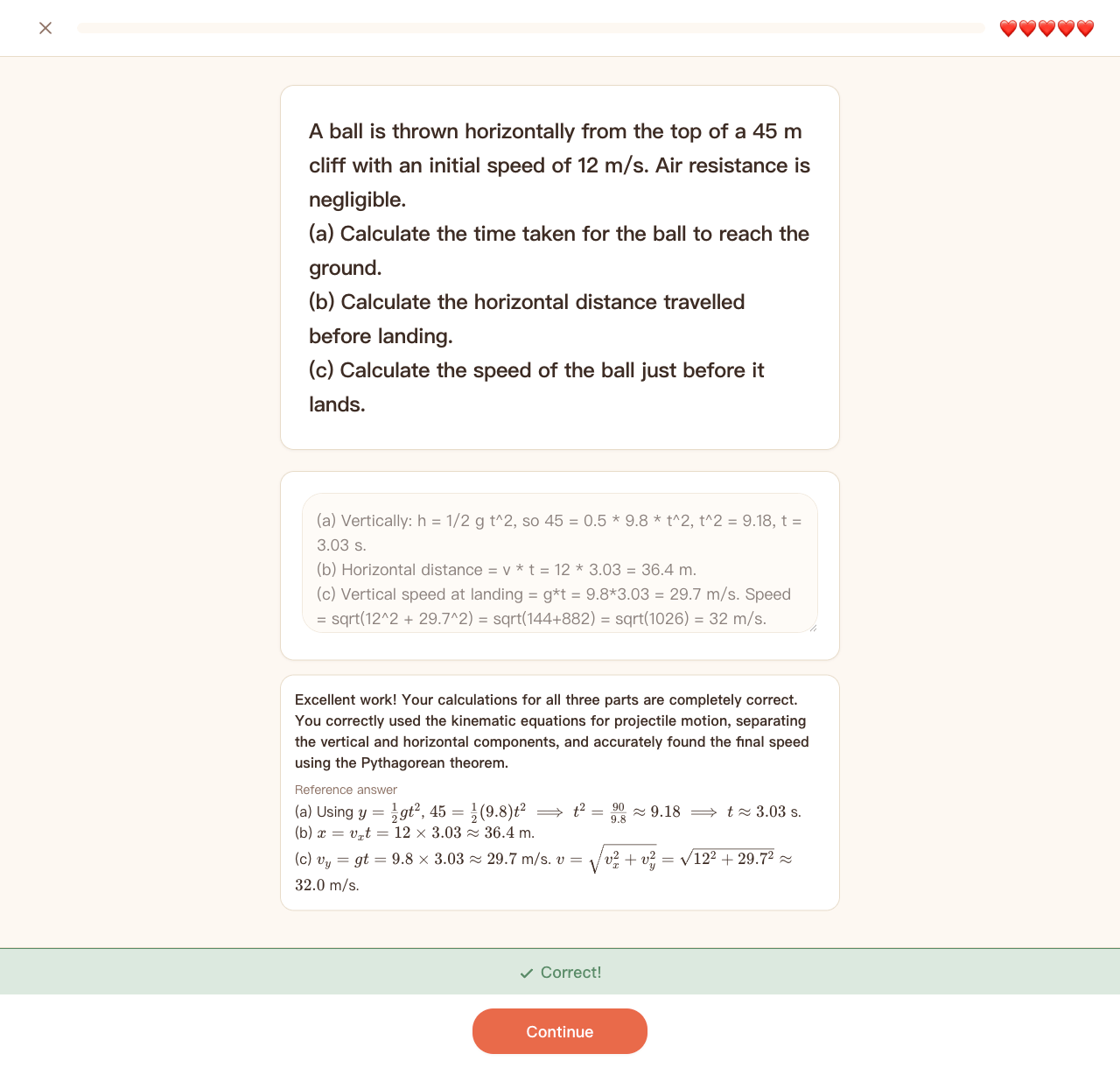
Choice and blank-filling questions are marked instantly against the key, with the explanation that was written alongside the question. Open-ended answers go to an AI grader, which reads your working against the reference answer and comes back with a verdict, a score out of 100, and a paragraph naming the step you got wrong. Get one wrong and you can ask for a variant — a new question on the same idea — and answer that one instead.
A chatbot will happily write you ten questions about a chapter. What it isn't built to do is run the weeks before an exam: keep the questions, remember what you got wrong, and tell you what's still shaky.
| General AI chatbot | Tali | |
|---|---|---|
| Writes practice questions from material you give it | Yes | Yes |
| Grades an answer you write out and says what it missed | Yes | Yes |
| Counts a topic as learned only after two correct answers, asked two different ways | — | Yes |
| Brings missed questions back on a spaced-repetition schedule | — | Yes |
| Shows, for the whole course, which topics are verified, shaky or untouched | — | Yes |
| Works out a daily pace from your exam date | — | Yes |
For understanding a concept on the spot, a chatbot — including ChatGPT's study mode — is excellent. Tali is built for the stretch before an exam, when the question is no longer "do I get this?" but "what don't I know yet?"
A bank of practice questions for organic chemistry is written against somebody else's course. It half-overlaps yours: a third of it is material your lecturer skipped, and the topic your exam leans on is the topic it happens to be thin on. Tali generates each question from the text of one of your notes, which came from one of your files, and it keeps the link — every question can show you the note it was written from.
A multiple-choice question can be guessed. An answer you have to write out cannot. Tali passes your working, the question, and the reference answer to a grader that returns three things: whether you were right, a score out of 100, and prose feedback that says which step broke and what your answer never mentioned. Having an answer marked this way costs tokens: being told exactly where your proof broke is a real model call, not a lookup in an answer key.
Every question has a variant button. Tali writes a fresh question on the same concept — same idea, different framing — and asks you that one, so you cannot pass by remembering that the answer was C. Generating a variant is generating a question, so it costs tokens; that is worth knowing before you lean on it. Answer the variant correctly and the original question moves forward in your review schedule. You graduated it by answering, not by telling yourself you knew it.
Start a practice session and Tali does not shuffle a pile. It puts what is due for review first, then the questions you have previously got wrong, then ones you have never seen — and it leaves out anything you answered correctly in the last three days, because being asked the same thing again on Thursday is not practice. The session is sized to whatever is left of your daily goal, so it ends when you are done rather than when the file runs out.
You know every paragraph by sight and could not reproduce one of them under pressure. Upload it, answer the questions it generates, and in ten minutes you know exactly which parts you have and which parts you were only nodding along to.
The book says the answer is 3.2% and stops there. It never tells you that your second step was wrong and the third one cancelled the error out. Write your working into an open-ended question and Tali marks the working, not just the final line — which is the only feedback that is any use on a proof or a derivation.
Tali tracks how you score per knowledge point across everything you have answered. When some of them keep coming up short, you can have it generate a fresh round of practice aimed only at the weak ones — rather than another undifferentiated pass over a chapter you mostly know.
You get 15 free credits when you create an account, no card required — one credit turns one source into notes, and every practice question written from those notes is included, so that balance is worth fifteen uploads before you spend anything. Answering a multiple-choice, fill-in-the-blank or true-or-false question is free, however many times you come back to it, and AI marking of an open-ended answer is free too. Chat runs one credit per twelve messages, voice one credit per two minutes. No subscription required; you top up when you want more.
You can, and for a quick check it works — ChatGPT's study mode will explain a topic and ask you about it. Tali is for preparing for a specific exam over days or weeks: every question comes from the material you uploaded and stays in that course, a topic only counts as verified after you answer it correctly twice, asked two different ways, the ones you miss come back on a spaced-repetition schedule, and if you set your exam date it works out how much to cover each day. A sensible split: a chatbot to understand something, Tali to check it stuck.
From your own material: fill-in-the-blank and multiple-choice questions (four or five options; the question tells you when to pick more than one). From a single note it aims for four to six fill-in-the-blanks and a couple of multiple-choice questions, so a chapter of a dozen notes comes back as dozens of questions, not five. Import a past paper and its questions keep their own format — including true-or-false and open-ended questions, where you type out the reasoning and Tali marks the reasoning.
Your answer goes to the model together with the question and the reference answer, and comes back as a verdict, a score out of 100, and written feedback that names the step where you went wrong. It is the least comfortable feature in Tali, and the one people keep. If the grading call fails — bad connection, mangled response — you can ask for it again.
They are written from the file you uploaded rather than from whatever a model half-remembers about the subject, so they stay on your syllabus and use your material's terminology. It is still AI: it can misread a table, or ask something the chapter never quite claimed. Every question carries its explanation, and there is a button that makes Tali walk through the reasoning. If a question looks wrong, check it against the note it came from — that note is one click away, and it sits next to your original file.
PDF, DOCX, PPTX, Markdown, plain text, and photos or screenshots of pages (PNG, JPG, WEBP, HEIC). Up to 30MB per file. A whole textbook is better uploaded a chapter at a time — the questions come back tighter, and you were going to study it a chapter at a time anyway.
It joins your review queue automatically, right or wrong, and comes back on a spaced schedule — sooner if you missed it, much later if it was easy. There is nothing to enrol and no deck to maintain; answering the question once is the enrolment. Reviewing what is already in the queue does not cost credits.
Drop in a PDF and get notes you can actually study from — then let Tali quiz you until you can explain it.
Upload the chapter you have to know cold. Tali writes the questions and schedules them — what you miss comes back tomorrow, what you know comes back in a month.
Upload a past paper and Tali reads it question by question — then writes you a note for each exam point it tests. CFA, PMP, CPA, university finals.
Upload the same PDF you'd drop into NotebookLM. Tali turns it into quizzes, grades what you write, and keeps bringing back what you got wrong — so you don't just chat with your notes, you learn them.
Ask your PDF anything and get answers grounded in the page. Then let Tali quiz you on it, mark what you write, and resurface what you missed — because chatting with a document isn't the same as knowing it.
If that's happened to you, the problem isn't effort — it's that nothing you're using can tell you which topics you only think you've got. Tali works from your own material, quotes the exact source for every supported point, and gives you that list.
ChatGPT is a great explainer. Tali is for the weeks before an exam: questions from your own material, a record of which topics you have actually proven, and the shaky ones brought back on schedule.
No set to build, no set to hunt for. Upload the chapter you're being tested on and Tali turns it into practice questions — and practising them is free.
